
Not Where the Problems Are — Where They’re Going
Upstream Finance in an Age of Payment Governance

Human Rights Foundation recently released Bitcoin for Nonprofits: A Guide to Help Your Movement Achieve Financial Freedom., a practical document aimed at organizations operating under genuinely difficult conditions: frozen bank accounts, blocked donations, currencies inflating faster than mission budgets can absorb, payment systems that are politically hostile by design.

For readers in stable democracies, it would be easy to receive this as important but distant — a guide for people in harder places, not a mirror for their own institutions.
The most interesting question is not where these problems already exist. It is where their logic is spreading.
I first heard about the HRF guide during a Zoom call with leaders from Brilliance Labs. In that same conversation, someone raised Dan Heath’s 2020 book Upstream.
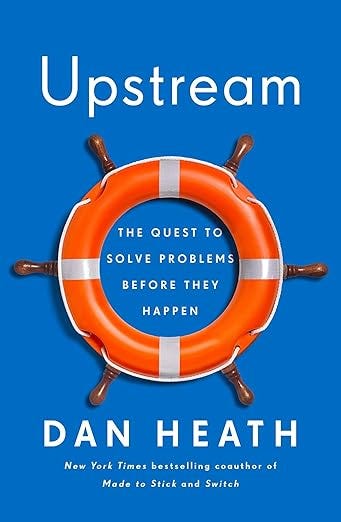
It opens with a parable that is quite striking. Two friends are standing by a river when they notice a child drowning. One jumps in to help. As they pull the child to shore, they see another. And another. They spend the afternoon rescuing children from the current — until one of them finally wades upstream to find out who is throwing them in.
Heath uses this image to diagnose something structural about how institutions respond to problems: nearly all of our energy goes to the rescue work downstream, and almost none goes to understanding the conditions that are producing the problem in the first place.
He argues that the organizations and leaders who change things are the ones willing to walk upstream — to ask what is generating the pressure, before it arrives as a crisis.
Most organizations think about finance downstream. Accounting. Payroll. Treasury. Fundraising. Compliance. These are legitimate concerns, and managing them well is real work. But the Heath question applied here is a different one: what happens when the payment system itself becomes part of the institutional risk model? What capabilities should organizations build before financial infrastructure becomes adversarial?
Because increasingly, payment systems are not merely financial tools. They are governance systems — and the architecture being built around them is unlike anything that has existed before.
Surveillance Architecture
Consider what is now ordinary.
Every digital transaction generates a record. Every record is retained. Every retained record becomes increasingly legible to machine intelligence capable of correlating, scoring, flagging, and predicting behavior across time and context at scales no human bureaucracy could sustain.
Artificial intelligence does not create this surveillance architecture, but it transforms its ambition. What was once limited by the cost of human attention is now limited only by the cost of computation — which falls every year. The practical result is that the gap between what can be observed and what is observed is closing faster than most institutions, let alone individuals, are prepared to understand.
Privacy is not being abolished by a single law or a single government. It is being dissolved by a thousand incremental design decisions, each of which seems reasonable in isolation, and which together are constructing something that has no real historical precedent.
You do not need a formal social credit system to notice the directional trend. Much of the underlying infrastructure already exists — distributed across private companies, government agencies, and international compliance frameworks that increasingly exchange data and operational logic.
The Canadian trucker protests brought emergency powers and account freezes into mainstream democratic conversation — not in an authoritarian state, but in one of the most stable liberal democracies on earth. PayPal briefly proposed policy language that would have allowed financial penalties for conduct it deemed misinformation, before reversing course after public backlash made the implications impossible to ignore. Debanking controversies in the United Kingdom and elsewhere have revealed how financial institutions quietly determine which clients are too politically exposed, too reputationally sensitive, or simply too inconvenient to serve. These are not identical events. They do not all point to the same actor or the same cause. But they share a structural logic that is worth naming plainly: payment systems are increasingly being used to govern — to determine who can transact, organize, save, fundraise, and participate in civil life. That is not a side effect. For some actors, in some contexts, it is the point.
Learning from the Edge
I spent nearly two decades in Turkey working in nonprofit and cross-border environments where inflation, currency instability, banking friction, and institutional improvisation were not abstract policy discussions but ordinary operational realities.
What that experience taught me, more than anything else, is that systems rarely become restrictive overnight. They accumulate layers — more compliance, more monitoring, more intermediaries, more dependence on institutions that increasingly determine not merely whether you possess resources, but whether you are permitted to move them. By the time the constraint is obvious, the architecture that produced it has been in place for years.
That is part of why the HRF guide struck me as more than a niche Bitcoin document.
Separate Edges, Similar Questions
But something else reinforced that impression. Earlier this year I attended the Bitcoin for Ministry Summit hosted by Brilliance Labs — a gathering involving leaders responsible for substantial global ministry finance and cross-border transfers. Jordan Bush leads TGFB and was one of the speakers. Here is a x post from him about it:

A different network, a different institutional culture, a different mission entirely. Yet the questions were remarkably similar. Not how do we speculate, but how do resources move? Where does friction accumulate? What happens when traditional rails become expensive, delayed, monitored, fragile, or politically constrained? What infrastructure should organizations understand before they urgently need it?
That convergence is worth sitting with. Human rights organizations and mission networks — very different communities, sharing increasingly similar upstream questions about money, trust, and operational resilience.
This is where trust architecture becomes more than a phrase. The question is not whether trust disappears. It is where trust is located, how it is enforced, and who retains the power to revoke access when systems come under pressure. Traditional finance concentrates trust inside institutional intermediaries — banks, payment processors, regulators, compliance systems, identity frameworks. Bitcoin responds with a different trust model: relocating portions of verification, custody, and settlement into open networks and cryptographic systems.
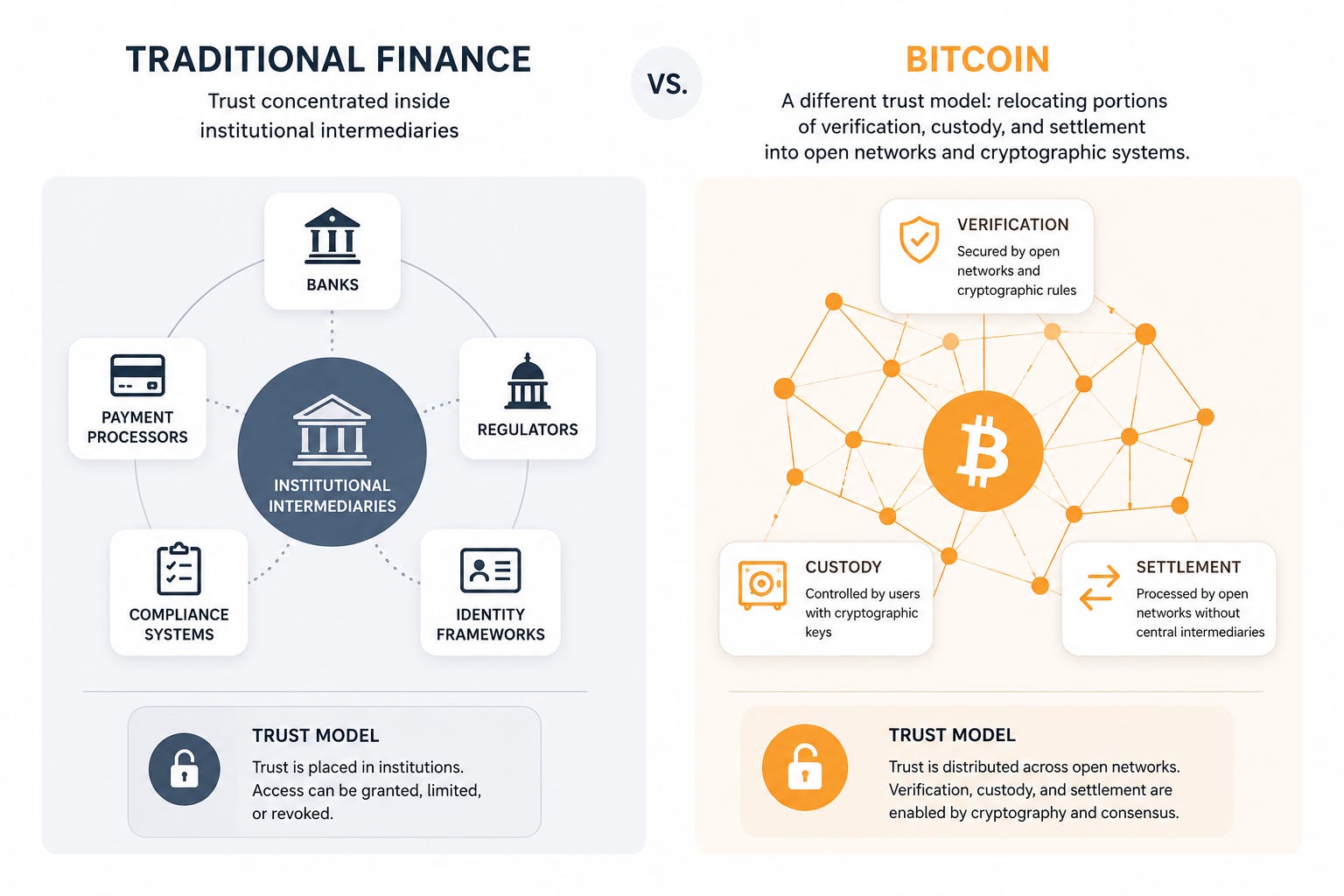
You do not have to accept that answer fully, or even find it convincing, to recognize the underlying institutional question it is responding to: where does trust live when payment systems themselves begin to function as governance systems?
Viewed through that lens, Bitcoin becomes interesting not primarily as speculation or ideology, but as contingency infrastructure — not necessarily for where the problems already are, but for where parts of the world may be going. Heath’s upstream walker does not wait for the children to appear in the current before asking what is happening further up the river. The organizations worth watching right now are the ones asking that question before the answer becomes obvious.
The edge does not always stay at the edge. Sometimes separate edges begin pointing toward the same future.
Further Reading
Human Rights Foundation — Bitcoin for Nonprofits: A Guide to Help Your Movement Achieve Financial Freedom
Dan Heath — Upstream: The Quest to Solve Problems Before They Happen
Paul Weaver writes about Bitcoin, technology, trust, and institutional change.
Drawing from nearly two decades in Istanbul, nonprofit finance, philosophy, and cross-border work, he explores how money, infrastructure, and governance shape human life.