
Spend and Replace
How to have "Diamond hands" and spend your Bitcoin at the same time.

The argument that you should never sell or spend your Bitcoin has grown long in the tooth. It made sense when the stack was small and the thesis was unproven. It makes less sense now that the thesis is proving itself in slow motion, one boring week at a time.
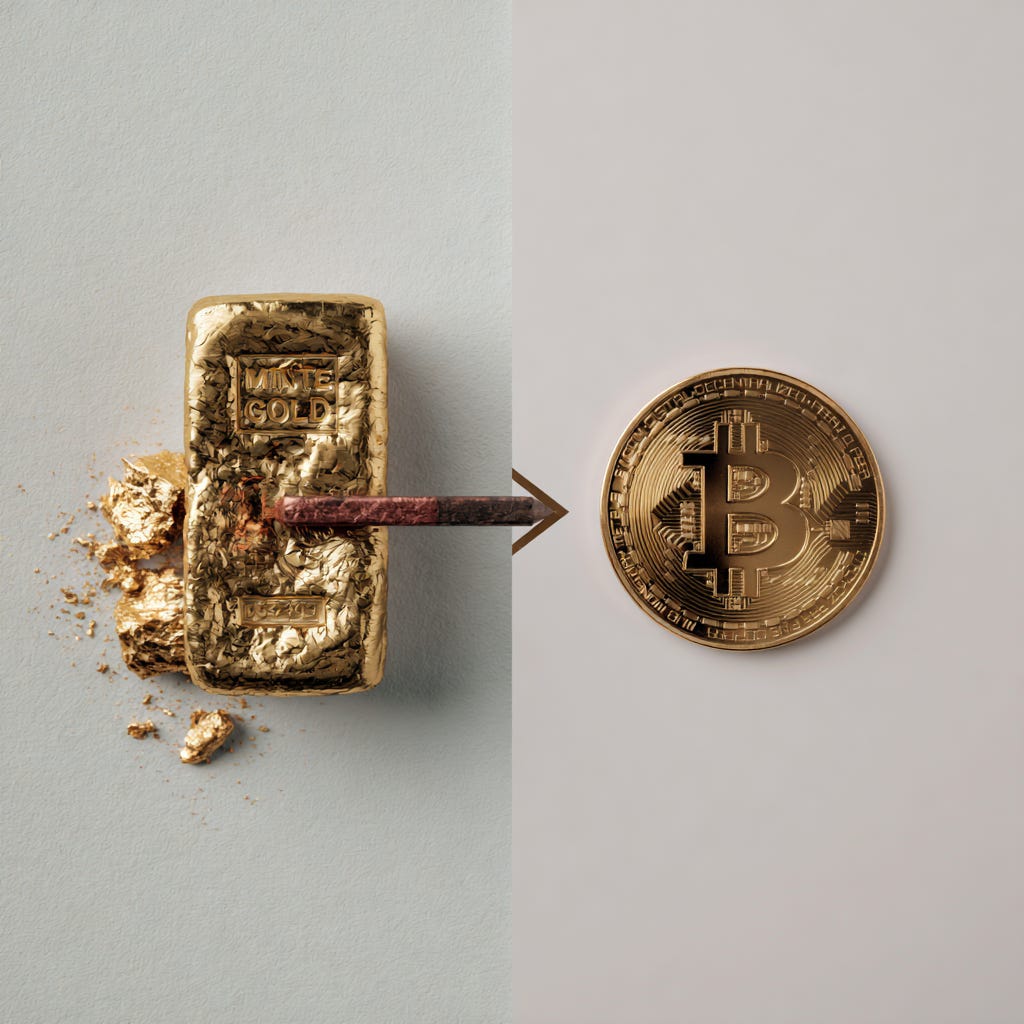
Monetization has no known timeline. What we do know is the order of operations, and Lyn Alden has mapped it as well as anyone. Every monetary asset in history has walked the same road. It starts as a collectible, something people want to hold for its own sake, before anyone is pricing it against bread or rent. From there it becomes a niche medium of exchange, useful to a small population with a specific problem, capital controls, deplatforming, a payment rail that otherwise does not exist. That niche utility is what first attaches a monetary premium to the thing. Only after that premium exists does the asset become a broad store of value, something a much wider population chooses to hold across time because its purchasing power tends to rise.
Store of value is the long bridge.
It has to be long, because volatility and network effects both work against it, and crossing it too fast just produces euphoria and a crash. On the far side of that bridge, and only on the far side, does an asset become a medium of exchange at scale, and last of all a unit of account, the thing prices themselves get quoted in rather than translated into. Gold walked this same road over roughly five thousand years, collectible to pharaohs, then a hoard, then Lydian coinage, then the standard the dollar itself was once pinned to.
Bitcoin is walking it compressed, digital and niche-useful from day one, useful to cypherpunks and the deplatformed before anyone trusted it as savings. The order has not changed in five thousand years and there is no reason to expect Bitcoin to skip a step. Collectible first. Then something narrower proves the utility. Then, slowly, trust accumulates into store of value. This is where we are now and why so many say “never sell your Bitcoin.”
Everything after this, the medium of exchange, unit of account, is downstream, and it has not arrived yet. You cannot build the downstream stages on an asset nobody yet trusts to hold value first. Bitcoin is still early in the store of value stage. Early does not mean paused, and it does not mean the rest of us get to sit out the meantime.
Here is the meantime. Bitcoin has spent weeks chopping in the high fifties to mid sixties. It fell to the low fifties in early July, the lowest level in almost two years, after closing June down sharply. As of this week it sits around sixty-four thousand. That is not nothing. But it is also not the wild ride the headlines keep promising.
This is the best argument for dollar cost averaging, and almost nobody states it correctly. It is not that Bitcoin is too volatile to time. It is that Bitcoin is not volatile enough, most of the time, to reward the attention you are paying it. The gains cluster in a handful of days a year. The rest is chop. If you are white-knuckling every red candle waiting for the 10x, you are spending your emotional capital on a market that is mostly asleep.
So the discipline has to be something other than waiting.
Spend and replace. Use your Bitcoin. Then immediately seek to replace it, and replace it at a premium.
Spend a thousand sats, replace it with fifteen hundred. Not dollar for dollar. Sats for sats, at 150 percent.
The 150 percent is the whole trick. Straight replacement just keeps you flat, a hedge against your own spending. It is defensive. The premium turns spending into a prompt instead of a loss. Every purchase becomes the starting gun for a small accumulation sprint. You are not avoiding the spend. You are using it.
Credit where it belongs. This idea surfaced, again, in the Q&A after my talk at Indy BTC Meetup 58, from a guy who goes by Relatively Irrelevant. He has dropped some version of this line before. The pen name undersells him.
Race organizers know something about this mechanism that Bitcoiners keep relearning. Put a marathon on the calendar and your training changes, not because the race guarantees anything but because it forbids coasting. A date on the calendar builds a structure, and the structure builds capacity, and the capacity is the actual point. The race is just the scoreboard.
Spend and replace works the same way, and the current chop makes it a harder scoreboard than a bull run would. At sixty-four thousand moving toward eighty, hitting 150 percent replacement is nearly free, the market does the work for you. In a multi-week band like this one, it is not free. You have to earn the premium through behavior. Work a little more. Spend a little sharper. Get honest about which sats were worth spending in the first place. The discipline only proves itself under load, and right now there is load.
This is also where the personal habit stops being personal.
The Indianapolis circular economy pitch has an obvious objection sitting inside it. If Bitcoin is supposed to circulate through local businesses and local hands, does that not just drain the community stack over time, one transaction at a time, until there is nothing left to circulate. Spend and replace is the answer, at the community scale that it is at the individual scale. Sats can move through this city, into a local business, into a neighbor’s hands, without the aggregate stack shrinking, because every spend carries its own replacement discipline built in. What looks like two separate ideas, personal savings behavior and community monetary theory, is one claim viewed at two distances.
It also settles an argument that has been fracturing Bitcoin discourse for years. Never touch your stack, on one side. It is just money now, spend it like any other currency, on the other. Spend and replace refuses both. It circulates now, while the store of value thesis is still doing the slow work it needs to do, without pretending that work is finished.
The rises will come, on their own schedule, on the roughly six days a year that decide the return. In the meantime there is a city, and a stack, and a discipline that asks you to do something harder than wait.
Paul Weaver writes at paulweaver34.substack.com on Bitcoin, faith, institutional trust, and the spaces between worlds.