
When Everything Feels Unstable, Start Closer to Home
On systems, responsibility, and why stability begins closer than we think.

Some days the news doesn’t just inform you. It hits you somewhere physical, a tightening in the chest, a low-grade nausea, the specific feeling of something being wrong that you can’t quite name or fix. I had one of those moments recently. Something shifted politically, economically, I don’t need to specify, and my first reaction wasn’t analysis. It was closer to grief.

The question isn’t whether systems grow.
It’s how far you let them move from home.
Most of us stop there, or we don’t stop at all. We share the thing. We argue in the replies. We move on to the next thing. The system trains us to respond at the same level it operates: fast, reactive, abstract. But I’ve started to think that response is the trap.
The question that stayed with me afterward wasn’t what do I think about this. It was a stranger one: why does so much seem to hinge on decisions made so far from my life?
Because that’s what it actually feels like now. One election shifts everything. One policy decision ripples into supply chains and prices and employment. One headline changes the collective mood for a week. The scale is enormous and the swings are real, and if you’re paying attention, you feel them.
This isn’t just perception. Authority really has concentrated - in governments, institutions, financial systems, global alliances. And it concentrated for understandable reasons. Centralized systems allow coordination at scale. They’re efficient. They can absorb complexity that no individual or community could manage alone. So we built them, and then we built more of them, and we handed over more and more trust in exchange for stability.
The writer and financial analyst Lyn Alden has a useful way of describing what happens next. In her book Broken Money, she observes that systems don’t usually fail by collapsing. They degrade. They stretch. They patch themselves together under pressure. And often, to hold things together as stress accumulates, authority becomes more concentrated, which is meant to stabilize the system but instead amplifies the consequences when the system moves. The cure contains the disease.
What’s changed isn’t the structure of these systems. It’s the environment around them. Information moves instantly now. Capital moves globally. Narratives shift inside of a news cycle. So we have the same centralized architecture, built for a slower world, absorbing inputs that arrive faster than any institution can thoughtfully process. The result is what we feel: volatility that seems disproportionate, instability that seems permanent, a political and economic atmosphere that swings in ways that feel, accurately, like they’re out of anyone’s control.
The distance is the thing that gets me. Not the instability itself, but the distance between where decisions get made and where life actually happens. Between the system and the person inside it. You feel this not because you’re too online or too political, but because it’s real, there’s a gap now, and most of us feel it even when we can’t name it.
The farmer and essayist Wendell Berry has been writing about this gap for fifty years, which is either prescient or depressing depending on the day. Berry is not a nostalgist, or at least not simply one. His argument is more specific: that modern life has become dangerously abstract, detached from particular places, from real obligations to real people, from the kind of knowledge that only comes from staying somewhere long enough to understand it. He’s written novels about a small Kentucky town, and essays about agriculture, and cultural criticism that keeps returning to the same idea: that a healthy life is rooted in a specific place, with real obligations to real people, and that we have systematically dismantled the conditions that make that possible.

When Berry talks about responsibility, he means something narrower than we usually do. He doesn’t mean responsibility for everything, for the climate, for institutional failure, for geopolitics. He means responsibility for what is actually in front of you. Your work. Your place. Your relationships. Not as a retreat from the world, but as the thing that makes engagement with the world possible. You can’t be grounded in the abstract. You can only be grounded somewhere.
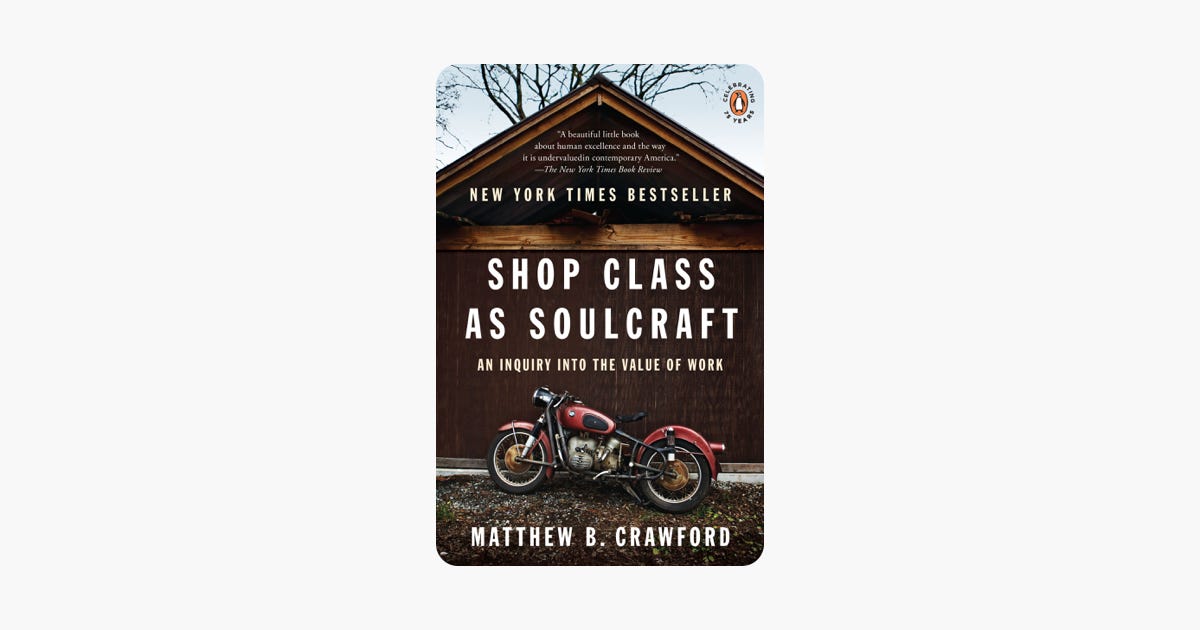
The philosopher Matthew Crawford adds a different angle. Crawford left an academic career to become a motorcycle mechanic, not as a stunt, but because he became convinced that something essential was being lost in knowledge work, something that only physical engagement with the world can restore. In Shop Class as Soulcraft, he argues that we’ve mistaken abstract knowledge for real understanding, and that working with physical things, things that push back, that either work or don’t, that can’t be argued with or spun, restores a kind of contact with reality that modern life progressively removes. You can’t narrative your way through a broken engine. The problem is real. The fix either holds or it doesn’t. That kind of honest feedback is increasingly rare, and Crawford thinks its absence has costs we don’t fully account for.
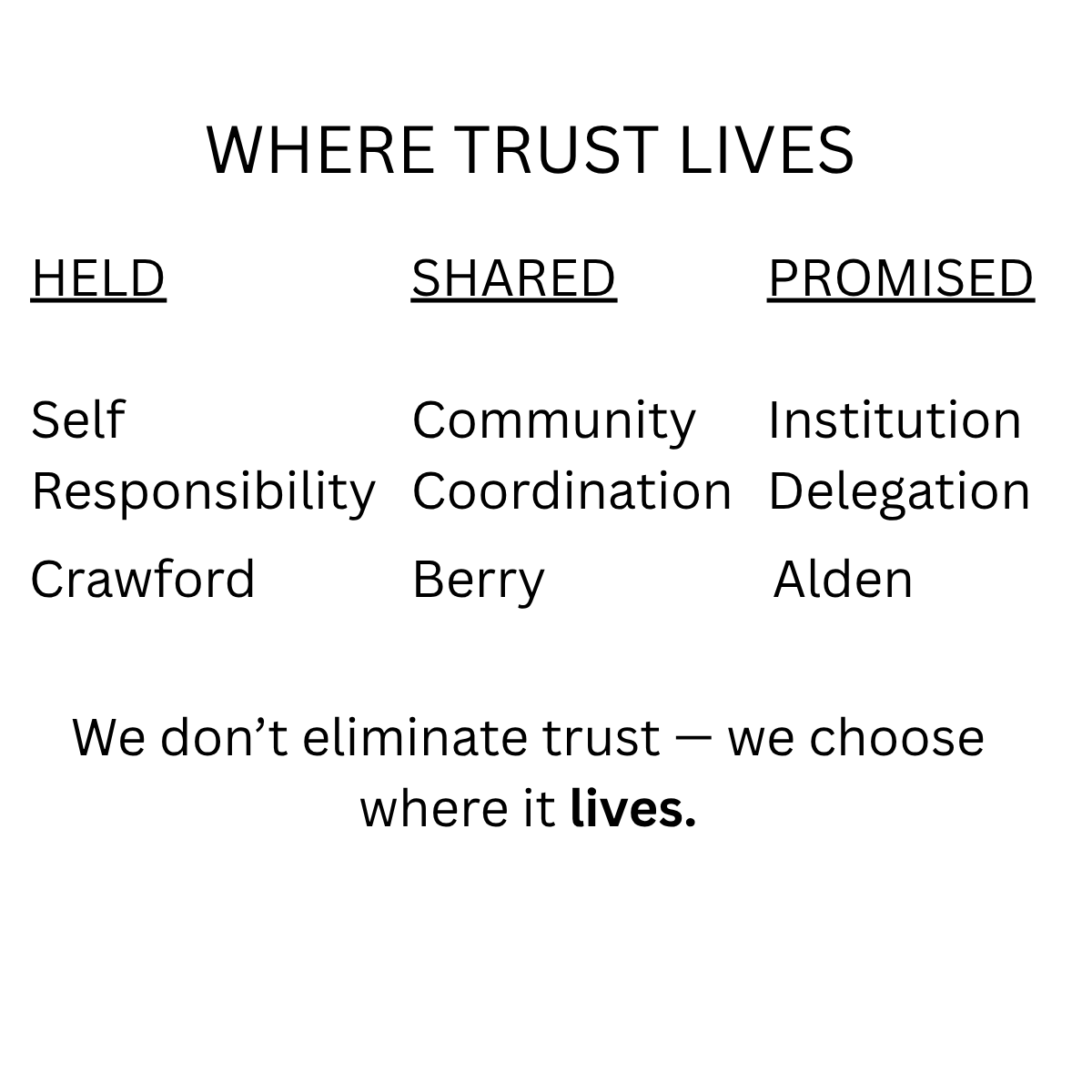
Berry and Crawford are making related points from different angles. Berry: responsibility is rooted in place. Crawford: competence is learned through practice. Together they’re describing something like the opposite of delegation, not handing trust upward into systems, but building it into your own hands and your own ground.
None of this is an argument for disengagement. You can’t opt out of large systems, and you probably shouldn’t try. The question isn’t whether to participate in the world as it actually exists. The question is what you’re building your life on top of.
The instinct, when systems feel volatile, is to grip them tighter, to pay more attention, to be more reactive, to try to influence the thing that feels unstable. But that strategy makes you more dependent on the thing that’s swinging, not less. The alternative isn’t to stop paying attention. It’s to build something that doesn’t require the system to be stable in order for your life to be.
That might mean learning a skill that produces something real. It might mean caring for a place, a garden, a neighborhood, a community, in ways that accumulate over time. It might mean building relationships that don’t live inside the same abstractions as the news cycle. None of this is dramatic. Most of it is quiet. But it’s the kind of thing that, over time, makes the swings feel survivable rather than existential.
We don’t eliminate trust, we can’t, and we shouldn’t want to. We move it. We redistribute it. We put more of it in places that can hold it. That’s the shift, and it’s available to almost anyone. Not all at once, and not as a solution to anything systemic. But as a foundation.
The system may keep swinging. It probably will. A human life doesn’t have to swing with it.
Further reading:
Wendell Berry — Jayber Crow (a novel that quietly embodies his ideas about rootedness and community) and The Unsettling of America (the direct argument).
Matthew Crawford — Shop Class as Soulcraft (on manual competence and the kind of knowledge that comes from engaging with reality directly).
Lyn Alden — Broken Money (on monetary systems, institutional fragility, and how systems degrade over time).